
Upland Predictors & Prognostications

By Nick Simonson
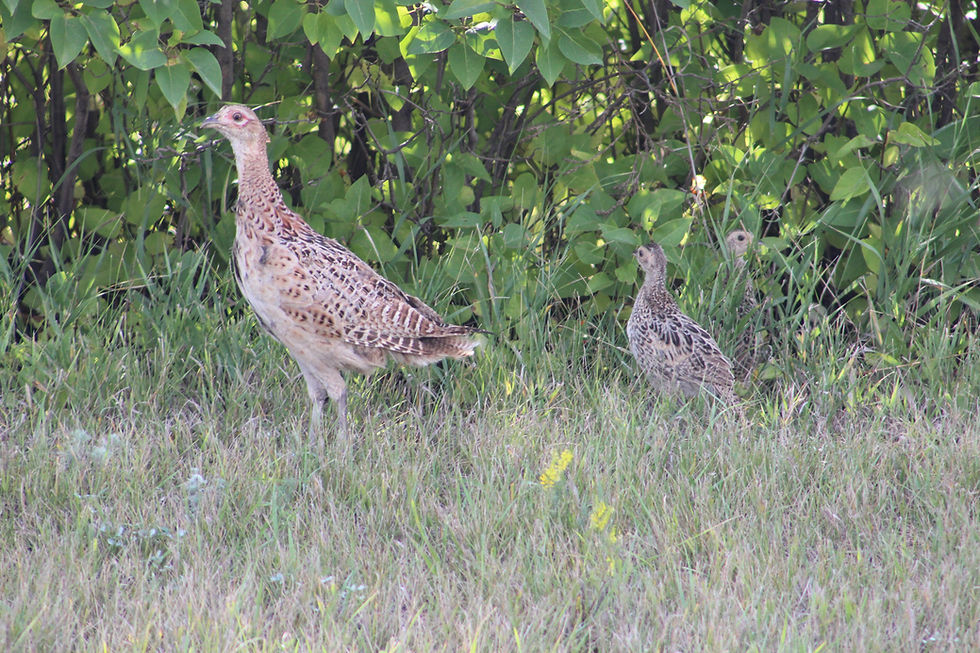
Last year’s tallies in the North Dakota summer upland bird roadside survey were a telling portent for the fall hunting seasons, as drops in numbers – from slight downward ticks in pheasant counts to bigger ones for grouse and partridge – reflected the changes hunters saw in the field almost exactly. Overall, hunters harvested three percent fewer pheasants, 24 percent fewer sharptailed grouse, and 25 percent fewer Hungarian partridge in the fall of 2025 compared to the season before, but such a decline wasn’t unexpected, according to RJ Gross, Upland Game Biologist with the North Dakota Game & Fish Department (NDG&F).
“It’s kind of crazy, they pretty much mirrored what our late summer roadside counts
were,” Gross stated of pheasant harvest numbers in 2025, adding, “everything was
down. Pheasant was down three percent, which was the same as what it was in our late
summer roadside counts. We figured it would be down, just because production wasn’t
as good last year.”
The primary driver for the lower numbers was the lack of recruitment, resulting from a
challenging spring and early summer which is the key nesting and brood rearing portion
of the birds’ year. A number of severe weather events, which included significant hail,
high winds, heavy rains and tornadoes, likely hurt early survival rates of pheasant
chicks. The population was buoyed, however, by strong overwinter survival of adult
roosters, which hunters found more of in the field last year.
“Last summer we had a lot of severe weather, tornadoes, hail, downpours in late May. I
think we had seven or eight inches of rain in one event, that just doesn’t bode well for
nest success, but I think harvest was boosted more than it should have been because
of such good overwinter survival. We’ve had three back-to-back-to-back really good
winters, so there’s a lot of older roosters that are out there. But coming back to why it’s
down, 75 percent of our harvest is juveniles, so with less juveniles, obviously it’s going
to be down a bit,” Gross explains.
In addition to those tougher rearing conditions, sharptailed grouse likely had a tough
time due to an increase of both avian influenza and west nile virus on the landscape.
The native upland birds are susceptible to both diseases, and with an albeit small
sample size, agency biologists like Gross were able to determine that roughly 25
percent of the birds they took blood draws from had antibodies for at least one of the
diseases, suggesting a more widespread presence in the population last year. This
likely added to the decline in grouse numbers observed and harvested by hunters last
fall. Both infections fluctuate seasonally, and tend to ebb and flow from year to year, so
it is possible that their presence won’t be as high in 2026.
Despite these downturns, Gross is optimistic with the recent change in the weather just
in time for nesting season, which typically runs from the middle of May with a peak
hatch period for pheasants happening in the middle of June. Recent warm temperatures, stable conditions, and lack of any severe weather coming out of a cooler
early spring can only help hen pheasants in the nesting process as they incubate their
eggs. Then after they hatch, the warmth will help those young chicks through the first
few tenuous days of life, when cold, damp conditions can increase mortality.
“With the warm coming up, the lows at night are going to be the big thing. When they
hatch, they can’t thermoregulate their own body temperature for 10 days, pretty much.
When it gets down below that 45 degrees, they don’t last very long. So, this warm
weather is good, this will keep everything growing, the vegetation will grow up really
nice. We need to keep getting that rain so we can have bugs. We don’t like bugs as
humans, but for an upland game bird, those bugs the first couple weeks of their life,
that’s all they eat and that’s what gives us a good juvenile harvest in the fall,” Gross
details of pheasant chicks’ early needs.
Gross and other NDG&F agents are currently conducting spring crowing counts through
June 10 to determine the overwinter survival of rooster pheasants. Then, from July 20
through the end of August, they will conduct roadside surveys once again to determine
the number of young-of-the-year and adult birds on the landscape. This year’s partridge
and grouse season is slated to start Sept. 12, with the general pheasant opener
planned for Oct. 10, with dates to be finalized in summer.
Simonson is the lead writer and editor of Dakota Edge Outdoors.
Featured Photo: The recent warm up will assist pheasant hens in their incubation
efforts, and will also help chicks survive after hatch, when they are most vulnerable to
cold conditions due to limited feathering. Simonson Photo.


Really helpful post! One thing I was curious about do you have any advice for Fresh Barracuda online in UAE? Would love to hear your thoughts.